
Our Scotland break this year took in visits to all the various branches of my family and covered the Lothians, Fife, Aberdeenshire, the highlands and the islands. Over the period we got ninety species including two”life ticks” and ten other “year ticks” Our trip is described in full below.
22nd July Moffat Community Nature Reserve
Our Scotland break this late summer started off with a drive from Manchester to Musselburgh and we again stopped off at Moffat Community Nature Reserve where we hoped to find Garden Warblers again but we seemed to be a bit late could we could find no trace of them. It was 10th of June last time we saw them so perhaps we were just too late this time.
The 23rd was spent visiting family rather than birding so it was the 24th before we got more birding done.
24th July The Isle of May.
When we left Musselburgh we drove to Anstruther where we stayed at the Bank Hotel (no sea view unfortunately and rubbish parking, two wailing babies in the restaurant all through dinner – apart from that ok) We got on the boat at 1:15pm and set off for what we expected to be a pleasant trip. As it turned out, although it was a beautiful day, the previous days weather was still on the sea and our passage turned out to be really rough. It was so rough that we had to land at the far end of the island and walk across the island to the visitor centre. Naturally we stopped avery so often which slowed us down but with only a couple of hours on the island we did not really need to be dropped off at the far end away from the best bird watching areas
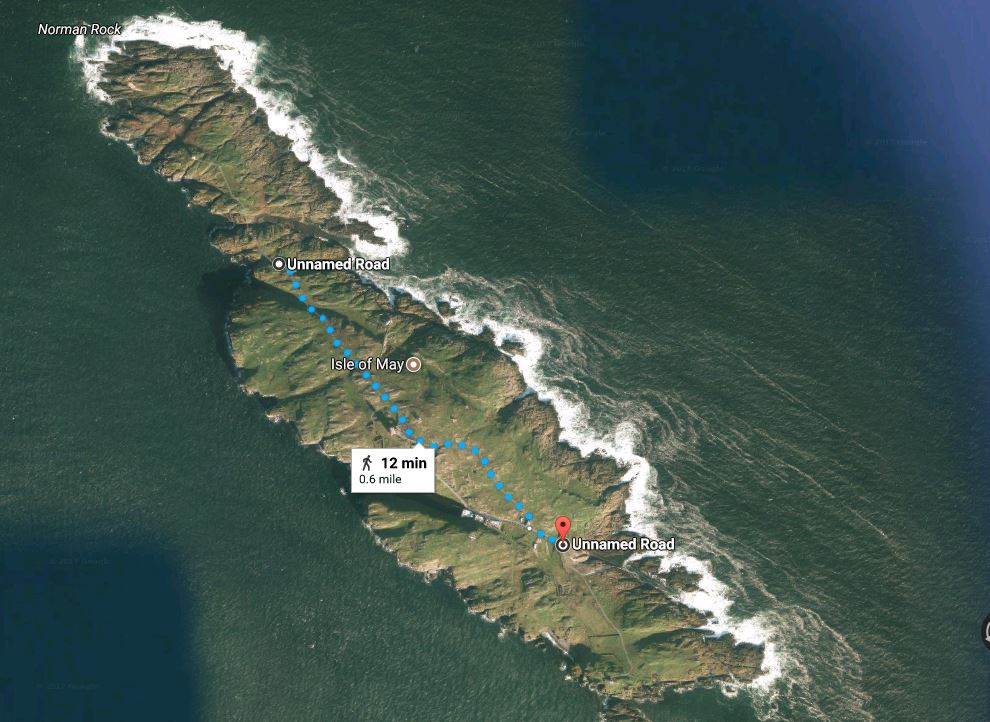 Be that as it may, we obviously got great views of Puffins, Guillemots and Razorbills as well as year ticks in the form of Shag and hundreds of Arctic Terns. Rock Pipits were plentiful as well and it is always great on the Isle of May. Time just flies, though and we had to walk back up the length of the island to reboard the boat. Thankfully the sea was a little calmer ont he way back.
25th July Fowlsheugh
On our drive up to New Deer, to visit realtives, we stopped off at RSPB Fowlsheugh, one of my favourite places to stop on that route. It was threatening to rain a little but it managed to stay dry – and hot – for our walk out to the stone hide at the end of the track where we saw half a sozen Puffins (more than usual) and hundreds of Kittiwakes, some Fulmar, Ravens, Yellowhammers, Linnets, Skylarks and, of course Common Guillemots and Razorbills.
We stayed for about an hour and a half and then headed off for New Deer but we made a further stop at Blackdog where we wanted to check out the area because it is often mentioned for sea birds. It’s an easy turning to miss – don’t go into the recycle centre by mistake – but we found it and drove down to the bottom of the path to a point where we could go not further. We got the scope out and immediately found a small group of Scoter close to shore but that seemed to be about it.
It wasn’t long before a chap came out of the only cottage there and started to ask us what we were looking for. Kevin was the owner of the cottage and he gave us good advice about parking in the area and said if we ever had a problem to say that he said it was ok ! He had bought his vottage about four years before and it stood on its own with a wonderful view of the sea and with a small woods down to the right. His idyll was soon to be ruined because there was a huge building site now behind his house and it is going to be the location of a sub-station for the rown of wind turbines they are going to build right in front of his cottage !!! We enquired further about all this it turns out that they are going to redevelop the whole area with a shopping centre, lots of houses and flats all sorts of other building. It is hard to imagine the changes that will have happened in a few years since he bought his cottage ! It may still remain a wonderful site for sea ducks, though, and we must go back there the next time we are up that way.
The afternoon was wearing on and we had to get to New Deer for a big family fmeal in a local restaurant.
27th July Newburgh Dunes
The next day was opouring down everywhere around us and we settled in for a nice day at home with family we do not see often enough. The day after that, the 27th, was much nicer and we went out for a walk around a lake in the grounds of a local castle. After that we stopped for a sandwich and then drove on for a walk along the beach ar Newburgh Dunes. There was no sight of Elvis the King Eider, unfortunately but someone we met said that he had been around a few days ago.
Because it was much later in the year we missed a lot of the birds usually there but there were still plenty of Common Eiders and good numbers of Common and Sandwich Terns. There were the usual Seals as well. We drove round to the raised parking mound round the corner and parked up there briefly. On the left side there was a very nice mixed group of a few Red Knot (some looking quite red), some Black-tailed Godwits, Dunlin and Redshank. We also got another Yellowhammer which was nice
On the 18th we drove from New Deer to Grantown-on-Spey but the weather was a little iffy so we drove straight there and enjoyed a few hours free in the afternoon to sort all our bags and stuff out and chill out for a bit before meeting John Poyner who we had booked to guide us around the highlands for three days. We met him in the evening and discusse where we might go. We ruled out Cairngorm because it was too late in the year for any of the birds up there – they will have already retreated to the tops of the mountains and will not come down for a bit. In fact it wasn’t the best time of year for other birds, either, but we did what we could.
29th July Looking for a Rose – coloured Starling
There had been god reports of a Rose-coloured Starling hanging out with a group of Common Starlings in the village of Embo – much more northerly than we had been on the mainland before – so we just had to have a look.
We made some stops on the way, the first being at Kessock Bridge where we got a nice Red Kite. From there we went on to Storehouse of Foulis which was a restaurant with shops and toilets and picnic tables and afforded a good view of the Cromarty Firth. You can walk to the waters edge where the views are good. We saw more Eiders, Goosander, Bar-tailed Godwits, Curlew, Redshank and, naturally, a lot more Seals.
Continuing on we went next to RSPB Niggs Bay which I had read about before but the tide wasn’t particularly good so the birds were a long way off. We did manage a few Curlew and Redshank but among the trees and bushes there were easier birds to see including Skylark, Yellowhammer, Meadow Pipit and Buzzard.
Further up the coast we came to the village of Embo and we spent a long time walking and driving around the houses and the caravan park looking in vain for the Rose-coloured Starling. It had been seen that day but we never did manage to find it before we had to leave. We did get a Turnstone , a Sandwich Tern and some Linnet and Pied Wagtials galore but no RCS !
John thought it was worth going up the coast a little more to the RSPB site at Loch Fleet where we did, at least, get a year tick in the form of Hooded Crow. In truth it wasn’t the best Hooded Crow we got (we got much purer forms on Isle of Rum later in the holiday) but for now it was some consolation. We also managed to get Red-breasted Merganser which was also a year tick. We got a couple of Buzzards also.
Next we headup north to the vllage of Brora and here we got sight of a Red-throated Diver flying like a bullet across the sea. Surprisingly I managed to get on it and followed it for quite some time. This was also a year tick – and one of my target birds for the holiday – so things were starting to look up a bit even though interms of numbers of birds it was a bit lacking.
30th July Looking for Divers and Eagles
On the second day of our guided birding we wanted to go to Lochindorb for Black-throated Divers and then the Findhorn Valley for Eagles. We got our first bird of prey of the day shortly after we set out when we got a brief view of a Merlin flying over the moors. We also got Red Grouse there though not in the numbers we are used to seeing – even though the grouse shooting season is just about to begin.
As we approached Lochindorb we saw a horrible sight on the road down to the loch; dozens of Common Gull chicks had been squashed on the road. We had seen Common Gulls nesting in the fields either side of the road aften enough but we were later in the year when their chicks were wandering around. It seems that they like to sit on the warm tarmac at night and John said it was the estate land rovers bombing around at night that led to the carnage. We also saw some Red Grouse chicks but they seemed less attracted to the road.
At the loch there were some Sand Martins and a Kestrel but the birds we were after were the divers and it didn’t take long to locate three Black-throated divers, a year tick for us. A bit of driving around eventually gave us much closer views and we were very happy in the end.
We drove up the Farr Road through the moors where we got a Stonechat before arriving at the Strathdearn Valley. We stopped at various places along the valley where we met people who had “just seen an Eagle” but every one that someone could point out turned out to be a Buzzard. We got a nice Wheatear and a Dipper and some Common Terns but basically between Buzzards and Kestrel that was about it for birds of prey. There was quite a bit of uplift so John suggested that we go up on the higher moors to see if they were there. Unfortunately they were not and we were extremely disappointed at not getting Eagles; this is perhaps the first time that we have not eventually seen an Eagle in this valley !
Such is life, however, so we put that behind us hoping to find one at some time during our stay in the Highlands and drove up to Loch Ruthven where we got a single Slavonian Grebe and a fe Little Grebes. It turned out to be necessary to go this far for the Slavonian Grebes as there are none at Avielochan this year. It seems that they nested too close to the path and photogrpahers frightened them off. This is of great concern to the Grant Arms Hotel as it is a major feature of the hide they own there and everyone is wondering what they can do now. It also seems that the gillie who is usually there from first light to last has not been so well this year and is not as vigilant as he has always been in previous years – as we can persnally attes to.
So, we had our Slavonian Grebe and nice views of it too in the sunlight. It was time for th long drive back. I think we both took turns to nod off but thankfully John stayed awake. We did drop in at Avielochan on our way ack and got a Goldeneye which was one for the holiday list. John popinted out where the Slavs nest had been and it was a pitifully poor choice by them as so exposed !
We rounded a long day off with a visit to Loch Garten and just by the entry hut, on the feeders, were lots of birds – mostly Chaffinches and Tits but also, eventually, a rather scruffy Crested Tit youngster and some rather more well groomed Siskin. Both these birds were year ticks and, obviously, the Crestie is a target bird in the Highlands.
31st July A Visit to the Black Isle and the Moray Firth
With the weather looking decidely uncertain around Grantown-on-Spey area we took the usual option and headed for the – usually drier – Black Isle. We hoped to get some good birds but were also looking to see the Dolphins at Chanonry Point.
We dropped in at Kessock Bridge first but apart from the Red-breaster Mergansers there was nothing especially interesting. We went from there along the north bank of the Beauly Firth, a particularly beautiful area with many gardens harbouring birds on the one side and the firth on the other. This is also a good area for Otters. Here we got a Red Kite and two Ospreys flying over the water looking for a meal. The Ospreys were particularly good and overall we saw quite a few of them throughout the holidays which was good as the male Osprey at Loch Garten apparently died this year and the female did not find another partner and migrated early so it’s fingers crossed for next year and a big loss of a major visitor attraction. There is more about this here.
We continued on to Munlochy Bay where we got rather distant views of some Knot, some Dunlin and a Greenshank. There was also a Yellowhammer singing just behind the hide and we had to watch out in the hide as a Swallow flew in to its nest from time to time and then back out through the window. The highlight, however, was an aural “life tick”. Right in the corn field in front of us a Quail was calling, a most beautiful sound that I had never heard before in the flesh. The corn was quite high and there was likely no chance of seeing it so we had to content ourselves with listening to it call for a few periods before it returned to its obscurity.
We then moved on to Chanonry Point but there was no room to park so we drove around the point a bit to an area where caravans park and we looked from there. There were no Dolphins and precious few birds so we thought we would try again later.
Our next port of call was Udale Bay on the Cromarty Firth. Here we got a good pair of Hooded Crows as well as a nice flock of Barnacle Geese. Large numbers of Common Gulls and, in amongst a flock of Redshank, we also found a single Ruff. There were Curlews aplenty as well as Oystercatchers.
One last place we went to that was entirely new to us was The Sutors of Cromarty. This was reached by driving up a single track and then walking up a path into a field. From here there were views of both the Cromarty Firth and the northern edge of the Moray Firth as it opens out into the sea. We did not see any birds but reallywe were there to see if there were any Basking Sharks or Dolphins etc. The water was flat as a pancake and we would most certainly have seen any large animals or fish in the water if they had been near the surface. As it happened all we got views of were the new Britain aircraft carrier – a huge beast and with binoculars you could actually see people walking about on it.
It was early afternoon by then and as we were driving back down we thought we would have another go at Chanonry Point. The situation there was even worse than before with a tremendous traffic jam at the bottom of the road to the car park. There is a roundabout there but there was so much traffic that people could not exit the car park because there was a queue to get in it that stretched back a long way. We abandoned any idea of parking or even finding another viewing area but as it happened we were stuck in traffic for about five minutes and during that five minutes we did manage to see a pod of dolphins after all – and reasonably good views considering it was from inside the car !!
We didn’t want to get trapped in a huge traffic jam on the single road (with the odd passing place) down to the small car park so we decided to head off home. As we drove back towards Grantown the weather started to get a bit dubious looking so we decided to tell John that we were happy to go straight back to the hotel as this would allow us a couple of hours to get our clothes and stuff sorted out and get most of our packing done for our early departure the next morning.
We met John for dinner in the hotel that vening and we chatted about our birding with hi. We agreed that it wasn’t really the best time of year for birding in the Highlands. Perhaps our biggest disappointment had been the lack of Eagles and, of course, no Capercaillie, Black Grouse or Ptarmigan. On the bright side though we had managed sixty-eight species and seven”year ticks” in the shape of Hooded Crow and Red-breasted Mergansers at Loch Fleet and Red-throated Diver at Brora on the 29th. On the 30th we got Black-throated Divers at Lochindorb, Slavonian Grebe at Loch Ruthven, Crested Tit and Siskin at Loch Garten and one”life tick” of Common Qual at Munlochy Bay.
These were good “ticks” for sure but perhaps as interesting was the fact that we ranged further north that we had been before so our north to south range with John had been ninety miles by road (or so) with the most northerly point being Brora. In some respects it was an interesting guided tour on the north east coast and this added to the reasonable birding meant that we left happy enough that we had done the break with John even though we missed target species.
1st August 2017 From Grantown to the Isle of Rum
We got up early on the morning of the 1st and had a quick continental breakfast at the hotel (even though breakfast hadn’t technically started) and, because we had settled up at reception the night before, we were able to drop our keys and get on the road immediately. We had a long drive down to Arisaig and we had a ferry to meet. We were unsure whether we would opt for five hours on Eigg or two hours on Rum but we decided to look at the weather and decide when we got there.
The weather did keep up for about the first hour but thereafter it started to rain heavily. We just had time to get a quick glimpseof a Short-eared Owl near Kingussie before the rain really started falling. The drive was about three hours with stops (109 miles) and we drove on the A9 then the A86 and down to the A830 where we crossed to the west coast. As we drove from Fort William to Arisaig the torrential rain added to the generally fantastic scenery with waterfalls by the dozens falling dramatically from the top of the mountains and sometimes gushing into the gutter at the side of the road that were especially deep to accomodate this kind of situation. It made driving very hard but the scenery was majestic and was unlike any views we had previously had in Scotland. It may have been the first time we have done this road (the A830) because we would normally go to Oban if we were going to the islands.
At Arisaig it was still raining so we decided to pay for the trip to Rum and decide when we got to Eigg what we would do. The boat was pretty full with people and with the rain falling there was a premium on the seating that was under cover. This, of course, had its limitations in terms of view but that was the choice.
The crossing wasn’t too bad but there wasn’t much widlife until we neared Eigg and then we started to see Gannets and gulls. We hoped to perhaps see Golden Eagle because two pairs nest on the island but it was too wet for them to be flying. We decided to stay on the boat and go further on to Rum. The sea got a little rougher as we headed iout more into the open sea but it still wasn’t like our boat trip to the Isle of May. This time nobody was sick and as we approached the island we saw more Gannets and a life tick Great Skua attacking one of them trying to force it to regurgitate its stomach contents. I say “Life tick” but this is really only since we started birding. Before that we had seen “Bonxies” on the Orkneys but this was the first one since we started counting.
A good year tick were lots of Manx Shearwaters though not as many as were led to believe we would see. Again, it might be that so late in the year they have already dispersed. Still there were enough to keep one looking on both legs of the trip. A small group of Puffins were seen and lots of Shags. I was pretty sure that I had also seen a Black Guillemot which was also a year tick.
When we reached the island the rain was still pouring down and was too wet to use optics really. We set off and only really had time to cross walk from the harbour up to the community centre where we had a cup of tea and a break from the rain. It relented a little on the way back doen (for that is all the time we had) to the harbour and here we also got probably the best of all the Hooded Crows we had seen. This pair looked like absolutely the real thing and not just one of the cross breeds that you get in the more lowland regions of Scotland.
As well as Eider on the water and Grey Heron we also saw prodigious numbers of Rock Pipits – they just seemed to be everywhere. We eventually got back to the boat and the rain had eased a bit. Now we were sitting on the boat being pestered by a plague of midges and we were definitley ready to leave just to get away from them.
Back on the open sea we were clear of the midges and with the rain holding off I decided to sit at the back of the boat and started to get good views of Manx Shearwaters again and then several very good views of Black Guillemot that removed any doubt I had. Largely the entertainment going back was looking at the Manx Shearwaters skimming past and then, after a brief stop at Eigg to pick up passengers, the final leg back to Arisaig became rather cold and boring. We were both pretty tired and poor Anne had a hour drive from Arisaig to Fort William still ahead of her.
When we arrived the reception was closed and I had to stand in the porch to get my waterproofs and boots off as it was pouring with rain again. It seemed like a long hour back to Fort WIlliam but we eventually got back there and just ate at the Beefeater next door before falling asleep.
2nd August 2017 From Fort William to Dumfries
We left Fort William in the rain and drove to Dumfries. It was a long 180 miles – a lot of it in the rain – and we eventually abandoned the idea of stopping anywhere to do birding and just got to the Premier Inn as soon as we could and chilled out a bit before going to Bruno’s Italian restaurant for dinner. The next day we drove to Manchester with the roads being pretyy good despite the weather until we hit a traffic jam. In the end we were glad to be home though, of course, we could not park outside our house so we had a few trips unloading the car.
Summary
In some respects the whole round trip had been fantastic. We had mixed family visiting nicely with birding and we had had reasonably good luck with the weather. We ended up with ninety species and one good life tick as well as a fair number of year ticks. Even though we missed certain target birds we always knew that it wasn’t the best time of the year. Perhaps the best part of the whole thing was seeing parts of Scotland that we had not been to before. The east coast past the Black Isle was very interesting and the whole route from Grantown-on-Spey down to Fort William and across to Arisaig and the Isles of EIgg and Rum really showed why foreign tourists love Scotland so much. It really is beautiful and it’s easy to take it for granted.
Scottish Trip Species List
| No | Species |
| 1 | Greylag Goose |
| 2 | Canada Goose |
| 3 | Mute Swan |
| 4 | Common Shelduck |
| 5 | Mallard |
| 6 | Common Eider |
| 7 | Common Scoter |
| 8 | Common Goldeneye |
| 9 | Common Merganser |
| 10 | Red-breasted Merganser |
| 11 | Common Quail |
| 12 | Common Pheasant |
| 13 | Willow Ptarmigan |
| 14 | Red-throated Diver |
| 15 | Black-throated Diver |
| 16 | Little Grebe |
| 17 | Slavonian Grebe |
| 18 | Northern Fulmar |
| 19 | Manx Shearwater |
| 20 | Northern Gannet |
| 21 | Great Cormorant |
| 22 | European Shag |
| 23 | Grey Heron |
| 24 | Osprey |
| 25 | Red Kite |
| 26 | Common Buzzard |
| 27 | Common Moorhen |
| 28 | Eurasian Oystercatcher |
| 29 | Northern Lapwing |
| 30 | Common Greenshank |
| 31 | Common Redshank |
| 32 | Eurasian Curlew |
| 33 | Black-tailed Godwit |
| 34 | Bar-tailed Godwit |
| 35 | Ruddy Turnstone |
| 36 | Red Knot |
| 37 | Dunlin |
| 38 | Great Skua |
| 39 | Common Guillemot |
| 40 | Razorbill |
| 41 | Black Guillemot |
| 42 | Atlantic Puffin |
| 43 | Black-legged Kittiwake |
| 44 | Black-headed Gull |
| 45 | Mew Gull |
| 46 | Herring Gull |
| 47 | Lesser Black-backed Gull |
| 48 | Great Black-backed Gull |
| 49 | Common Tern |
| 50 | Arctic Tern |
| 51 | Sandwich Tern |
| 52 | Rock Dove |
| 53 | Common Wood Pigeon |
| 54 | Eurasian Collared Dove |
| 55 | Short-eared Owl |
| 56 | Chimney Swift |
| 57 | Common Swift |
| 58 | Common Kestrel |
| 59 | Merlin |
| 60 | Eurasian Jackdaw |
| 61 | Rook |
| 62 | Carrion Crow |
| 63 | Hooded Crow |
| 64 | Common Raven |
| 65 | Sky Lark |
| 66 | Sand Martin |
| 67 | Barn Swallow |
| 68 | Common House Martin |
| 69 | Crested Tit |
| 70 | Great Tit |
| 71 | Eurasian Blue Tit |
| 72 | Eurasian Treecreeper |
| 73 | Eurasian Wren |
| 74 | White-throated Dipper |
| 75 | European Robin |
| 76 | European Stonechat |
| 77 | Northern Wheatear |
| 78 | Eurasian Blackbird |
| 79 | Song Thrush |
| 80 | Common Starling |
| 81 | Dunnock |
| 82 | White Wagtail |
| 83 | Meadow Pipit |
| 84 | Rock Pipit |
| 85 | Yellowhammer |
| 86 | Common Chaffinch |
| 87 | Eurasian Siskin |
| 88 | European Goldfinch |
| 89 | Common Linnet |
| 90 | House Sparrow |