Some Notes on Dissenters and the Church of Scotland
Religion was important to Scots in all walks of life. The Church was the vehicle for expressing inner spirituality and changes to its forms of worship could endanger your chances of salvation, so differences of view within a religious group, that to us may look minimal, were in the 18th and 19th century of great existential importance. Your eternal soul could end up in heaven or hell if you made the wrong choice.
Apart from the wellbeing of one's eternal soul, the Church was crucial in all aspects of everyday life. It was responsible for education, health, welfare and discipline. The state functions that most of us now regard as matters of politics and the judicial system were then largely subject to the authority of the Church.
After a long history of conflict, at the "Glorious Revolution” of 1688, the Church of Scotland was finally recognized as a Presbyterian institution by the monarch.
Churches which are not part of the Church of Scotland are often referred to as nonconformist. By the 19th century a majority of the population was non-Conformist. There were two categories of so-called nonconformist churches in Scotland:
• Dissenters or sometimes called seceders or secessionists - those who seceded from the main church but were still Presbyterian in form. Such dissenting churches included Associate, Covenanters, Burghers, Anti-burgher, Free church, Reformed Presbyterian, and later in the 1800's the United Presbyterian and others.
• Nonconformists - Those who were not Presbyterian in form, such as Episcopal, Methodist, Quaker, Baptist, The Church of Jesus Christ of Latter-day Saints (Mormon), or Catholic.
Regarding, dissenters, the “First Secession”, in 1733, was an exodus of ministers and members from the Church of Scotland. An important demand of the seceders was the right of a congregation to choose its own minister. These issues had their roots in seventeenth century controversies between presbyterian and episcopal factions in the Church of Scotland. This demand was complicated by the fact that most ministers, by tradition, were the younger sons from the aristocratic families, and those same families were usually the local landowners. The local landowner therefore would often act as a "patron" to the church, not only through gifting of money, but through supply of their own relatives to fill the role of minister.
In December 1733 they constituted themselves into a new presbytery. In 1734 they published their first testimony, with a statement of the grounds of their secession, which made prominent reference to the doctrinal laxity of previous General Assemblies. In 1736 they proceeded to exercise judicial powers as a church court, published a judicial testimony, and began to organize churches in various parts of the country. The membership of the 'Associate Presbytery' steadily increased, until in 1745 there were forty-five congregations, and it was reconstituted into an 'Associate Synod'.
Opponents of the Burgher Oath on theological grounds became known as the Anti-Burghers - showing a distinctive independence of conviction and an unwillingness to compromise over sincerely held beliefs. The Burgher and Anti-Burgher factions thus formed rival, independent synods – the General Associate Synod (Antiburghers) and the Associate Synod (Burghers). Both of these factions also split within themselves, and the non-conformist churches became very complicated indeed. In 1847 several of these factions united as the United Presbyterian Church.
Secessions in Church of Scotland
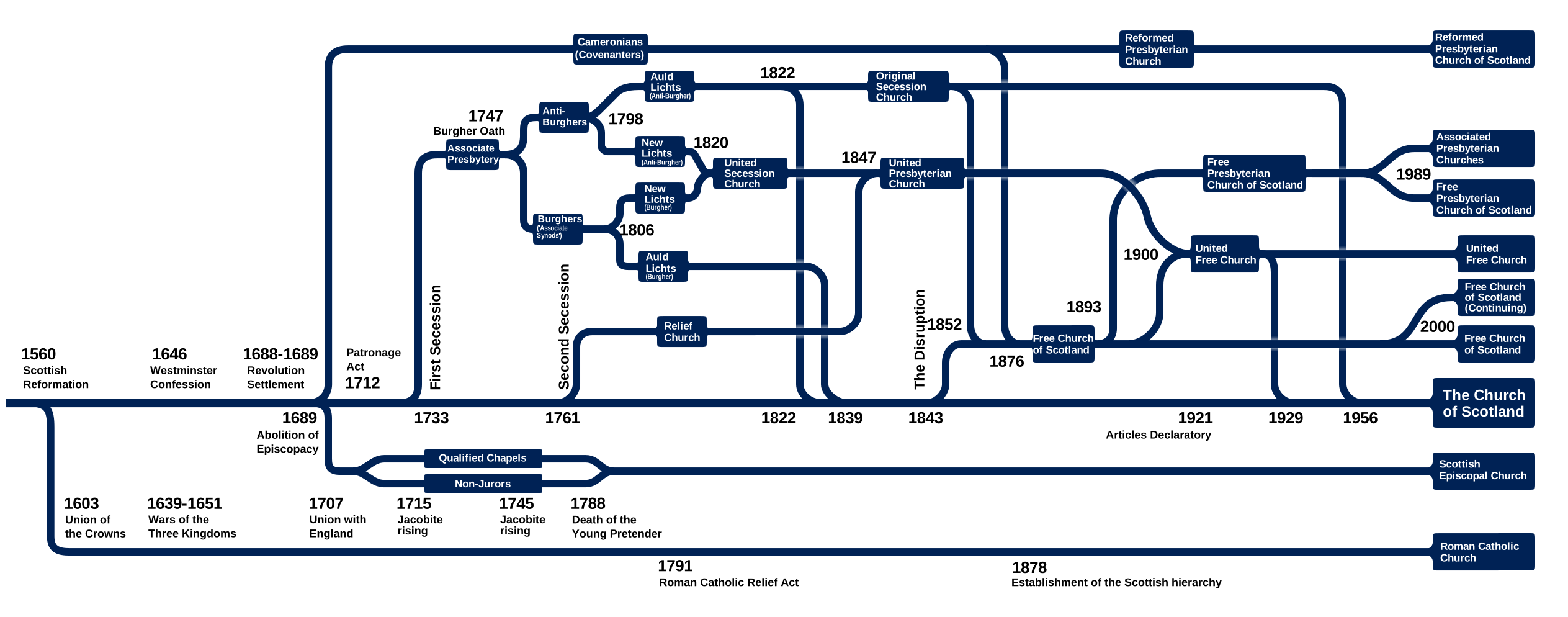
A Chronology of Useaful Dates in Dissenting Church History
1552 Roman Catholic parishes are ordered to keep a register of baptisms and banns of marriage.
1560 Protestantism is established and the authority of the pope abolished.
1592 The Presbyterian Church is formally established.
1600 Scotland began using January 1 as New Year's Day.
1610 James VI establishes the Episcopal Church.
1638 The Episcopal Church is abolished by the General Assembly of Presbyterians at Glasgow. Although the government did not recognize this move, Episcopalians were persecuted. They sometimes hid or destroyed their registers or did not keep them at all.
1640 An estimated five percent of the parishes of the Presbyterian Church are keeping records by this date.
1641 Charles I and the English Parliament acknowledge the Presbyterian Church in Scotland.
1661 The Episcopal Church is reestablished under Charles II.
1690 The Presbyterian Church is permanently restored and becomes the Church of Scotland.
1700s During the eighteenth century, particularly after 1730, many nonconformist groups form. Many preachers come from England, but they usually keep only personal records of conversions, and many conversions are not recorded locally. Prominent among these groups are the Baptists, Methodists, and Congregationalists (Independents).
1733 Four ministers break away from the Presbyterian Church and set up the Secession Church.
1745 The Secession Church divides. The new denomination is known as the Anti-Burgers Church.
1752 Three ministers secede from the Presbyterian Church and form the Relief Church. By 1790, this church has about 150,000 members. The Relief Church keeps its own records. Scotland adopted the Gregorian calendar.
1783 The government imposes a tax on every christening, marriage, and burial entry recorded in church records, causing many entries not to be registered.
1792 The laws against Episcopalians are repealed, allowing them to worship and keep records.
1820 Parishes are required to keep register books.
1829 Roman Catholics are permitted by law to buy and inherit property and keep records.
1834 many non-Church of Scotland ministers were allowed to perform marriages
1843 Ministers break away from the Presbyterian Church and form the Free Church.
1847 The Secession and Relief Churches combine to form the United Presbyterian Church. At that time, the Free Church had five million members (some settled in Ontario, Canada), and the United Presbyterian Church had two million members.