
Highland Birding Holiday Day 1 : 8th October 2013

Crested Tit, Grantown-on-Spey
We arrived at the Grant Arms Hotel early afternoon on Monday the 7th October and we were pleased to find that our room was already prepared for us so we could check in early. We were pleased that we had been given quite a nice room on the first floor and, although it didn’t have much of a view, it was quite spacious and very comfortable. We got all out luggage in and sorted out and after that we took a walk around Grantown-on-Spey to get the lay of the land. In truth there aren’t a lot of attractions in the town with just the one pub and a couple of closed hotels but there is a post office, small supermarkets and a newsagents and bakers etc. so they do have all the essentials and we expected that we wouldn’t be going out much after dinner at the end of long birding days.
That evening we met with our birding guide for the next three days, John Poyner of Highland Nature who explained to us that his other bookings had all cancelled so we would have him all to ourselves. Accordingly he had swopped his minibus for a car and this was to be how we were to get about for the following three days. He ran through the rough schedule for the three days but, of course, this would depend upon the weather. The forecasts had been good for the area until we got closer to the actual time and then they started to be less certain. Anyway, nothing was going to stop us from enjoying the three days !
The notional schedule had been described on John’s web site thus :
Tuesday 8th : After an (optional !) early start before breakfast we will explore the forests, lochs and moors around Strathspey where we aim to find Crested Tit, Black Grouse, Capercaillie, Scottish/Parrot Crossbill, Red Grouse, Dipper and many other species. We then head to the spectacular Findhorn Valley (Strathdearn) in search of Golden and White-tailed Eagles as well as other raptors. Red Squirrel are common in the forests and in Strathdearn we will have the chance to watch rutting Red Deer as they bellow from the rocky crags above us.
Wednesday 9th : The Moray Firth. Wintering sea duck should be starting to arrive as well as this being the peak time for autumn migration so we may be able to catch up with any rarities on this coastal hot spot! We bird from the picturesque Spey Bay all the way along to Findhorn. Long-tailed Duck, Common and Velvet Scoter, Slavonian Grebe, Divers, Skuas, Black & Bar-tailed Godwit, Purple Sandpiper are possible as well as another chance for Crested Tit in the dune pinewoods. We will also keep an eye out for the famous Bottle-nosed Dolphin population of the Firth as we go.
Thursday 10th : Cairngorm Mountain and Black Isle. An action packed day where we will attempt Ptarmigan by viewing the upper slopes of the mountain via the funicular railway then head to the Black Isle., north of Inverness. Here we will visit the famous Chanonry point for hopefully a closer view of Dolphins and some sea-watching if there is ongoing passage. All four Skuas are possible, Common and Arctic Tern as well migratory waders passing through. Moving on through the rolling farmland of the Black Isle with it’s Red Kites and finch flocks, the first Pink-footed Geese from Iceland should be arriving as well as many other waders and wildfowl at Udale Bay, making their first landfall here in the far north of the UK. The Cromarty Firth holds a wintering population of several hundred Scaup, Red-breasted Merganser, Slavonian Grebes and we may get a late Osprey fishing over the bay.
Of course this was all subject to the weather and we dis have some mixed weather. However, John used his local knowledge and experience to fit all out visits around the weather so that we could make the best of it. In essence, we were to cover as many sites as might prove fruitful for a wide range of bird species in the counties of Inverness-shire, Ross and Cromarty, Nairnshire and Moray.
DAY 1
We took up the option of a pre-breakfast start on our first day in to try to see Black Grouse and Capercaillie. We met John at 7am and he drove us to moors near Dorback (on the A939 SE from Grantown-on-Spey) in the Strathspey area.
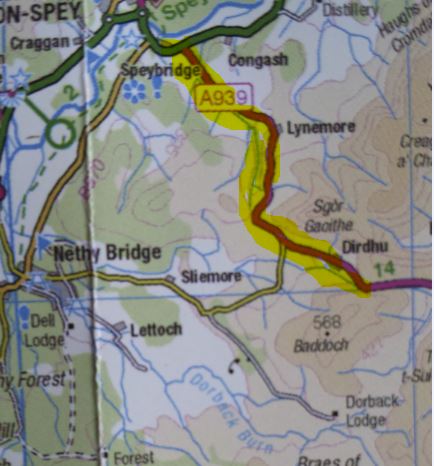
Dorback
He told us that the best way to avoid putting the birds off was to drive slightly past the lek rather than parking the car right opposite it. Through the early morning gloom we could make out one bird avoiding the damp grass by perching of a fence post. The more we looked the more we could see until eventually we found ourselves looking at a group of perhaps 14 male Black Grouse all displaying to a single female – they do still display in August apparently not just Spring. We spent about twenty minutes watching these birds and whilst doing so we also saw Roe Deer, Pheasant, Meadow Pipit, Red Grouse and a Buzzard.
We then drove back to the hotel via a circular woodland road through the Abernethy Forest near Nethy Bridge.

Abernethy Forest
We turned back on ourselves a couple of times but we could not see anything. We were on our last try before going back to the hotel when, suddenly a Capercaillie strolled out from the forest and calmly walked across the road a few hundred yards in front of us. We got a good view of the bird with our eyes but by the time I could get my bins up and focused the bird had reached the other side of the road and flew off into the forest. Search as we might we could not locate it again. In fact in subsequent days we drove via this road trying to find it again but we never did. The day we left we ran into John as we were getting into the car to leave and he told us that he had rediscovered the bird but for us this was a bit late and we had to do with the one brief but wonderful view on our first morning of birding.
We were ready for our breakfast by now so it was back to the hotel for something to eat, a cup of tea and then we were ready to meet John again. His plan for us was to go up Cairn Gorm on the funicular railway and look for Ptarmigan and Snow Buntings up there but first John took us to a bit of Anagach Forest that was a very short drive from the hotel.
We parked up and took a short walk down a path in the woods until we came to a nut feeder suspended from a tree. We stood there patiently and after about fifteen minutes we were rewarded with our first view of a Crested Tit – with the Capercaillie, our second “life-tick” of the morning ! We also saw Red Squirrel and Coal Tits and Chaffinches galore. When we felt we had had a good view of the Crested Tit (there only seemed to be one) it was time for us to head for the mountains.
We got great views of the surrounding landscape as we rode the funicular railway up to nearly the top of Cairn Gorm. Suddenly it was much colder and very blustery. We found a bit of shelter and scoured the neighbouring rocks looking for Ptarmigan or at least Snow Buntings. One thing soon became evident to us and that was that rocks covered in patches of lichen can be confusingly similar to Ptarmigan – that being the point of their seasonally varying plumage, naturally !!
We saw a few Red Grouse, some Ravens and a Buzzard but unfortunately no Ptarmigan and no Buntings. It seemed as if we had peaked a little too early and we were very disappointed to have to leave the mountain without a sighting. However, if we had stayed there all day we might still not have got lucky and John had other birds he wanted to show us so we reluctantly had to accept that we were going to be thwarted this time.
We got back in the car and drove around some of the lochs; John thought that Loch Morlich might give us some late Divers but here there were only Mallards! By lunchtime it was decided that we should drive to Strathdearn which is sometimes called the “Findhorn Valley” because the River Findhorn winds its way through the valley. Here it was hoped that we might have a chance of seeing Eagles – either White-tailed or Golden !
We took the A9 northwards turning off the main road in the direction of Findhorn Bridge. There we turned left to follow the rough road that follows the meander of the river going through Woodend and Corrievorrie. There are a number of lay-bys along this road and we stopped at several of them and scanned the mountain tops for Eagles.
At first all we saw were Deer, Kestrel and Buzzard and, more promisingly, a large number of Ravens. John informed us that where there are a lot of Ravens there are often Eagles, perhaps attracted by a prey item. We had our lunch and drove up and down and again we were nearly giving up but we thought we would go a bit further down the valley and we came to as lay-by where there was another group of birders and, as we pulled up, we could see that they were very interested in something or another.
As we got out the other groups leader announced that he had a Golden Eagle in his scope and we all rushed to get our scopes and bins sorted. Sure enough there was one Golden Eagle, a juvenile probably, then another and amazingly eventually e had four Golden Eagles in our scope at the same time ! Although it was quite distant it was close enough to get a proper id in the scope and one of the Eagles even helped out by perching on a rock right on the skyline.
Our day seemed to have picked up again and this is, of course, the way with birding – you just never know if you are going to dip out or see something amazing !
By now it was getting towards mid afternoon so we returned to Grantown-on-Spey by via a circular route around a part of Farr Moor, just north of the River Findhorn. En route we continued to see Red Grouse, a single male Black Grouse and Wheatear, Meadow Pipits and Starling as well as skeins of Geese and Swans overhead that were the signature note of the three days in the highlands – autumn migration clearly well afoot.