
RSPB Minsmere 3rd May 2016
The 3rd was reserved solely for a visit to RSPB Minsmere which we had been to a couple of years before but then we didn’t have a full day free so we were a little bit limited in what we could do. This time we took two of the major trails on the site which gave us lots of species of birds and a few “year ticks”
Before we got going, we were caught by surprise at the huge number of Sand Martins, all busy building their nests and collecting twigs and such to line them with. I didn’t even know that Sand Martins did this so it was fascinating to watch Quite often a pair would perch together in their particular opening in the sandy wall that has been developed for them. This is so much nicer than plastic tube and concrete based “Sand Martin banks” that one sees at reserves and looks really natural. There were so many so close to us and showing so well that it was hard to drag ourselves away but we had to.
The “coast trail” which is a 2 mile circular walk, takes in a hide on the north side, two hides on the east side that are next to the sea but which point towards various scrapes and areas of open water, a hide on the south side and a last one west side. All these hides face onto the same body of water with islands and scrapes but each hide has better views of some species that favour different niches.
We started at the North hide which afforded us good views of the large number of Barnacle Geese that the site is known for. There were obviously Greylag and Canada geese but the latter were relatively few in number. The Greylag were more numerous and also seemed to already be leading little flocks of goslings through the inlets and reedbeds.
There were plenty of Lapwings and Black-headed Gulls, a few Shoveler and lots of Avocet. At the far side of the scrape we could see lots of Terns but they were too far away to tell exactly which kind. Our next port of call was the East hide where we could see these birds better.
At the east hide we could see that the Terns were a mixture of Common and Sandwich, the latter a “year tick” for us. There was also a substantial flock of “Bar-tailed Godwits”, another “year tick” again. A fourth was a single mature Mediterranean Gulls and a pair of “first year” “Meds”. No that we would have known it if a reserve staffer had not told us ! This is not the first time that I have had top assistance on Gull identification in this hide.
We also saw a few Oystercatcher and Redshank as well as a small group of Turnstone and a group of Dunlin in breeding plumage.
We continued to the public hide but this was pretty much the same view. What stood out about the walk between the beach and the path to the hides was the number of Stonechat on the gorse side and Sedge Warblers on the scrape side. We also heard Wrens and got a brief but satisfactory sight of a Cetti’s Warbler that flew across the path in front of us, singing both before and after the brief flight.
At the end of the path, which at this time is public, we turned right back onto the reserve, the gate being opened and closed for us by some very obliging ” Nuclear Police” , a title I had not seen written on a police van before. As you walk down this long path there are intermittent reed stands in open pools of water on one side and full reed beds on the other. again the air was full of Sedge, Reed and Cetti’s but our best surprise was brief, but good, view of a male Bearded Tit, yet again another “year tick”.
We stopped briefly at the a south hide and from here we could see another flock of Godwits but this time they were the resident Black-taled rather than the passage Bar-tailed Godwits. Other than that it was pretty much a view of the same birds as we had seen previously so we continued on giving the last hide a miss before returning to the visitor centre for some tea and a scone.
After lunch and a bit of a rest we went on the second circuit, the “Island Mere trail”, a 1.5 mile circular walk that takes in both reedbeds and woodland. We started at the “Bittern hide” where we did not see or even hear a Bittern but, as I recall, it was the same the last time we were there. However we did see a pair of Marsh Harriers and some Hobbies in the distance. I got the merest of glimpses of a Bearded Tit flying at speed from one stand of reeds to another. There was a Little Egret and a Little Grebe and, lastly, a lovely Kinfisher, radiant in electric blue in the sunshine.
We then moved on to the Island Mere hide where we still didn’t see a Bittern but we again got even betters views than previously of a group of Hobbies flying over the reed bed and and further excellent views of two Marsh Harriers, a male and a female, displaying beautifully for about fifteen minutes. I think that there was a third one in the reeds. We also managed to see our only Buzzard of the day. Unfortunately for me, my extensive notes of which species had been seen at which hides (which was written on a few small sheets taken out of Anne’s birding book) was suddenly blown clean out of the window and into the reed bed below !! Thus the list below is a list of all the species seen that day no matter where on the reserve.
We took the woodland walk back in the hope of seeing a Nightingale, as we had done before, but with no luck. We had to settle for Blackcaps, Wrens and endless Robins. This wlk led us to the viitor centre again but rather than cup of tea we opted to drive to the Ship Inn at Dunwich for a pint and a discussion on the lovely, sunny day of successful birding we had had. Just as it started to get cooler we returned to Halesworth and “Poachers Cottage”
Year Ticks : Bar-tailed Godwit, Bearded Tit, Mediterranean Gull and Sandwich Tern
Bird Sightings : 3rd May RSPB Minsmere
| Species | Count |
|---|---|
| Greylag Goose | 20 |
| Barnacle Goose | 40 |
| Canada Goose | 10 |
| Mute Swan | 5 |
| Common Shelduck | 4 |
| Mallard | 20 |
| Northern Shoveler | 10 |
| Tufted Duck | 8 |
| Common Pheasant | 2 |
| Little Grebe | 1 |
| Little Egret | 2 |
| Eurasian Marsh Harrier | 3 |
| Common Buzzard | 1 |
| Common Moorhen | 2 |
| Common Coot | 6 |
| Eurasian Oystercatcher | 4 |
| Northern Lapwing | 10 |
| Common Redshank | 30 |
| Black-tailed Godwit | 30 |
| Bar-tailed Godwit | 20 |
| Ruddy Turnstone | 8 |
| Dunlin | 6 |
| Black-headed Gull | 100 |
| Mediterranean Gull | 3 |
| Great Black-backed Gull | 2 |
| Common Tern | 20 |
| Sandwich Tern | 30 |
| Common Kingfisher | 1 |
| Eurasian Hobby | 3 |
| Eurasian Magpie | 4 |
| Eurasian Jackdaw | 4 |
| Carrion Crow | 2 |
| Bearded Tit | 3 |
| Sand Martin | 50 |
| Barn Swallow | 20 |
| Eurasian Blue Tit | 6 |
| Eurasian Wren | 4 |
| Cetti’s Warbler | 4 |
| Common Chiffchaff | 4 |
| Sedge Warbler | 6 |
| European Robin | 6 |
| European Stonechat | 4 |
| Eurasian Blackbird | 6 |
| Common Chaffinch | 20 |
| Eurasian Bullfinch | 1 |
| European Goldfinch | 2 |
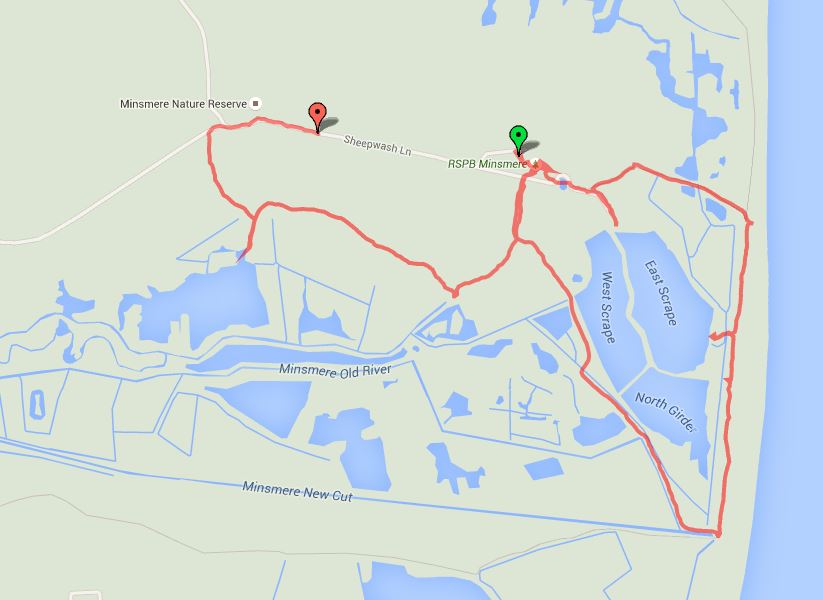
Minsmere Walking Route